
Episode 1: Squeaky Sonnets
Is it a bird, a plane? No, its a New York City rat!
So excited to share this first episode, where I talk to Dr. Ralph Emilio Peterson about his work following rats around New York City with a mic and a camera. We talk about how he first got interested in tracking rats around the wild, what sorts of differences he’s noticed already in wild rats that hasn’t been observed in lab rats before, and what his hopes are for future studies! Spoiler: They involve a “research dumpster” and rat “hearing” tests, among other things.
Take a listen to learn more, and also hear some recordings of rats “talking” that we can’t perceive with our own ears! You can also hear a clip here, overlaid over my thermal camera imaging of NYC rats in a community garden:
I, as many other New York City residents, see rats every day. But I was surprised how much fun it was to quietly look for them in the dark, and watch them hop around on camera! However fun, these unsteady videos with finger pointing popping up every once in awhile (thanks Anat :D) are definitely not ideal for the types of sophisticated analyses Dr. Peterson et al. developed in their study. He kindly sent over a sample of the videos they actually used, which you can see here:
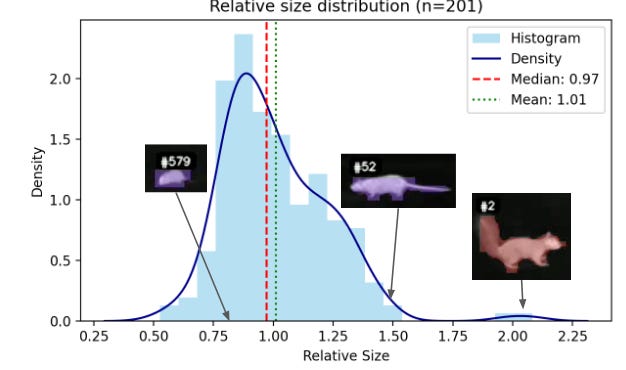
The difference is obvious, right? If you read the full preprint, you’ll be able to see some more details about how they analyzed the videos. This is the graph that Dr. Peterson and I discussed that measured rat sizes from these thermal imaging video, including the “rogue squirrel”:
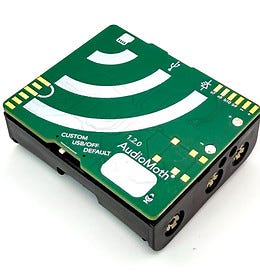
While the thermal camera used in the study is on the pricier end, the microphone is surprisingly accessible, which is what makes it potentially viable as a way of tracking rats throughout the city as a pest control method. It’s been used by scientists to record from birds, bats and.— after adding a protective case — even fish! Here’s a photo of it from the designer’s website:
Thank you so much for reading, I had a great time making this first episode of Frivolous Science, and beginning this exploration of what sorts of studies are (or aren’t) worth funding. If you’d like to get notified when the next episode comes out, you can subscribe on your podcast app, as well as on this substack:
I’d also love to hear your thoughts after listening! Do you think this type of research should receive public funding? What do you think these rats are talking about? Any theories about whether wild rats need hearing aids or not? Share your thoughts in the comments:
Full Credits
Creator & Host: Houda Khaled
Link to the preprint: https://www.biorxiv.org/content/10.1101/2025.07.21.665423v1.full
Music by Blue Dot Sessions (www.sessions.blue):
Spark
Jadie Grange
Highway 94
GriddleKake
Soundbite Sources:
Rand Paul, Fox and Friends, 5/15/2025
Joyelle Nicole Johnson, Wait Wait… Don’t Tell Me!, 11/22/2025
TRANSCRIPT
(ARTWORK DESCRIPTION: Text saying “Frivolous Science” with “S” as “$”. Purple and orange gradient background with simple cartoon rat in white with sound waves coming from its mouth. In the background is a city skyline.)
(AMBIENT LEAF CRUNCH SOUNDS)
HOUDA KHALED, HOST: Do you wanna tell me where we are?
SHWETA PATWARDHAN: Yes. We are in the M’finda Kalunga Garden on the Lower East Side of Manhattan, walking through the, over on the pathways with crunchy leaves, and so far no rat signs.
KHALED: On a cold night in November, community garden volunteer Shweta Patwardhan took a few of us on a tour, to look for rats.
PATWARDHAN: If you see pink flags, that’s where we found a rat burrow. Oh, so they might be close to where the burrows are actually. Then we could use your camera.
NATALIE OPPENHEIMER: Oh, yeah?
KHALED: Yeah.
ANAT MANO: I think there is a rat squeak.
KHALED: As in many other parts of the city, M’Finda Kalunga Garden has historically had a big problem with rats.
PATWARDHAN: We do try to avoid piles of garbage in the garden.
KHALED: I hope so!
In cooperation with the city, garden. volunteers have been making efforts to reduce rat presence. Not just to stop them from eating garden vegetables, but because rats can act as disease vectors to humans, damage infrastructure, and even cut wires to start fires.
PATWARDHAN: Sorry, Houda. Not that many rats, I guess.
KHALED: Yeah. It seems like your garden’s doing a great job. That’s awesome.
And while it took some hunting at first...
PATWARDHAN: Yeah, overall, I’m happy about this development.
KHALED: Eventually we found quite a few!
PATWARDHAN: Oh, there’s definitely something there. Oh, wait, wait. There it is! It’s running.
OPPENHEIMER: Oh my God, it’s running.
PATWARDHAN: Wait, is there two, are there- there are two rat!
KHALED: There’s two rats. Yeah. Oh, what are they doing?
KHALED: Using a thermal camera - in my case, a cheap one from Home Depot - we could see the rats pretty well, even in the dark or in their burrows.
PATWARDHAN: Is that…Huh, oh wait, do you think that’s it? Oh my gosh. I think we can see it in the burrow. Look, can you see it? How it’s moving around? Yeah. Whoa, that’s a lot deeper than I would’ve guessed.
KHALED: It’s coming back out. Oh, it just walked out.
PATWARDHAN: Oh my God.
KHALED: What do you think about your community garden pest management now?
PATWARDHAN: Well, technically this is outside of our formal jurisdiction, so I’m still feeling pretty good.
KHALED: All right. We need Shweta on it. Oh my gosh, there’s so many here.
Hi, I’m Houda Khaled and this is Frivolous Science where I talk to scientists conducting seemingly silly science that kind you hear complaints about on Fox News...
SOUNDBITE OF RAND PAUL, FOX & FRIENDS: Well, I compliment Secretary Kennedy and the Trump administration for finally saying, enough’s enough. We’re not gonna keep fundingfrivolous and crazy research.
KHALED: ...and even NPR...
SOUNDBITE OF JOYELLE NICOLE JOHNSON, WAIT WAIT… DON’T TELL ME!: Those scientists know we need to cure cancer, right?
KHALED: …but that can have a big impact on our lives.
Today, I talk to scientist Ralph Peterson, whose passion for understanding rodent vocal communication might indirectly lead to new solutions for rat pest control, just by listening in on their conversations.
KHALED: Ralph Emilio Peterson is a Ph.D in Neuroscience from New York University, and he’s also my former classmate. For his dissertation, he looked at the ways that rodents communicate vocally. He found some interesting things, like that gerbil families have their own unique dialects compared to other gerbil families. He’s now a Postdoctoral Fellow at Basis, where he’s continuing his work studying animal vocal behavior in increasingly naturalistic environments. Would you say that’s accurate?
RALPH PETERSON, PhD: Yes, very accurate. Nailed it.
KHALED: Yeah? Also, you’re a musician.
PETERSON: Yeah, I grew up, playing jazz trumpet. That was of my first loves in life and passions. and that was actually what inspired me to go to grad school and study, the auditory system. I was always fascinated by. How music could invoke emotion. There’s this really surreal state that you can enter when you’re playing music and specifically jazz, when you’re improvising and, it feels like you’re transported somewhere new. it’s this very kind of euphoric state. And so I was always curious how it could be that music, could. interface with your emotions, how they’re so intertwined.
When I went to grad school, I decided that I wanted to study sensory processing, auditory processing to figure out, how sound hits the ear and travels through the brain and may or may not interact with, with emotional systems. And I specifically focus on vocal communication because, it’s so central to everyday life and, every species. And Very much intertwined with emotion. For example, if you’re on the phone with, a family member and they’re not feeling well, they’re sad or something, you could tell in their voice that they’re not doing great. So the, voice in a sense is like a readout of, I don’t know, the soul, if you will. There’s a lot of information other than just the semantic content of the vocalization that you can read out from speech.
KHALED: Yeah, I think that’s pretty intuitive in people’s experiences and I feel like that’s a really good example.
So then, what made you veer towards animal research rather than, I don’t know, looking at humans and emotions? It’s hard to read out the emotion of a gerbil or a rat.
PETERSON: Yeah. it’s a good question. there is some great work going on in, in human, vocal communication, people like Eddie Chang or Michael Long are doing experiments in humans as they’re, as they’re freely, vocally communicating. But there are some caveats, these are people going in for procedures to treat strokes and whatnot. It’s a very stressful environment. I thought it’d be interesting to look at rodents. They’re a standard model organism in neuroscience. They’re highly social and they speak in this ultrasonic frequency that humans can’t hear, so there’s a bit of, mystery as to what they’re saying.
There had been, decades of research in gerbils, specifically studying their auditory system because it was very amenable to auditory experiments. And in a parallel but totally non-overlapping area of research, there’s been a lot of field work done in gerbils to study their social capabilities. They have this kind of intricate social structure. They live in these underground borough systems with multiple generations pups in there, of children in there.
KHALED: Versus other animals where the pups would leave the nest and form their own families.
PETERSON: Exactly, yeah. That’s like the human model where you grow up with your siblings and then you are forced to disperse when you’re 18. that’s not the case in gerbils. It’s like a big, Catholic family where they’re all helping take care of each other. But the unique and kind interesting thing about gerbils is that some of the older siblings will take on the role of caretaker. So they’ll undergo like a sexual suppression where they actually cannot biologically reproduce. So they assume this role of caretaker called alloparenting. There’s, a study showing that the mother will force dispersal of specific individuals in the family based off of criteria that we don’t really well understand. And there’s studies in other, rodent species that show that in their burrow systems, they have dedicated chambers for using the bathroom or caching food or just nesting.
So there is this idea of they’re living in a big group that’s not just a random big group. There’s structure to it. Yeah. And there’s hierarchy and, So I wanted to understand how they use vocalizations to coordinate their social hierarchy and basically understand how the brain processes vocalizations at a neural level.
KHALED: So what makes you think that’s the likely way that they’re communicating? Because there could be all sorts of methods of communication. They can touch each other, look at each other, and bite each other, or use pheremones.
PETERSON: Yeah, absolutely. I think that it’s likely that those other senses are involved as well. But, if you think about a day in the life of a gerbil or a rat, or most rodents living underground, there’s not many visual cues. They have this really acute sense of hearing, and vocalize a ton. If you record a family of gerbils 24/7 like I did on my PhD, they’re vocalizing hundreds of times per hour. They’re not vocalizing to no end, I assume, and in very low lit conditions, I assume they’re using it for something. And the act of talking is, one, metabolically expensive. Like you need to expend energy to actually talk. Two, it’s, evolutionarily potentially precarious because you’re exposing yourself to predation.
So there are species that can hear in the ultrasonic range, like cats for example, that could in theory hear them and run after them and attack them. So all that to say, I don’t think that they’re vocalizing just because they can. I think that there is a purpose and, it’s not clear in the field what that purpose is.
KHALED: Yeah, but then, the way you say it makes it sound like it’s actually pretty obvious. So then there’s the alternative question, like, why haven’t people been able to figure that out? Does it have to do with it being computationally difficult, since that’s a big focus of your thesis and preprint?
PETERSON: Yeah, it’s, difficult. it’s just technologically difficult generally. So yeah. On the computational side, quantifying behavior in animals is a difficult thing to do. As I mentioned, there were decades of field work that were done in gerbils that were done by humans that wrote down on pen and paper field observations. Over the last, 10, 15 years or so, there’s been this, emergence of, machine learning in the field of animal behavior and neuroscience.
Where instead of, looking at animals, behave and writing down with pen and paper, what they’re doing, you can actually use machine learning to extract their calls and, quantify their vocalizations in principled fashion.
KHALED: And what are the benefits of that? I feel like we’ve learned so much from pen and paper and just observations. But what great information do we get by collecting such large amounts of data and quantifying it?
PETERSON: Yeah, so one of the things we found in our studies in graduate school, we found that the gerbils emitted new and different vocal types than had previously been observed. And we think that this was in part because we put them in a very kind of naturalistic situation. So a family altogether, and we recorded 24/7 for the period of three weeks. So we just eavesdropped on whatever they did.
If an ethologist, 30 years ago were to do the same study, they would have to listen back to this audio over three weeks and like individually annotate every single time there was a vocalization. it’s just not a very scalable approach if you want to record data at scale.
And I think what scale gets you is insight into new and potentially, rare events that occur. A lot of these field studies, if you read back to the methods, they like, observed behavior for two hours because, that’s all they could muster basically.
One of the things I began to appreciate and become increasingly inspired by in my PhD was this idea that animals evolved to thrive outside of the laboratory. Yet we bring them into the laboratory and kind of constrain them relatively reduced environments in order to gain experimental control to understand how the brain works.
So the idea that the lab most that we study has been born in a lab, was shipped to us in a FedEx box from one lab to another lab and lives in a small, very reduced cage. And then we go in and we do a bunch of neuroscience experiments and claim that we’ve discovered something about how the brain works feels a little unsatisfying to me. Because this mouse, evolved to live outdoors and, in, the natural world and with its family and with the stress of predation,
KHALED: And not unlimited food.
PETERSON: Yeah, exactly. So there’s this idea that everything that we understand about the brain comes from this limited set of behaviors that are studied in the lab and whether or not they generalize to how the brain works outside of the lab is still an open question.
KHALED: So you think that in auditory communication, there’s a limited repertoire? So that a lab mouse will only communicate in more limited ways because they’re not having all of the life experiences that a normal animal has, or that a human would have - to extrapolate from these animals to humans. So that if you look at an animal in a real environment that’s experiencing a full life, you’ll find out new things about auditory communication as well.
PETERSON: Exactly. You nailed it. Yeah, that’s a hundred percent the thesis for, this type of work is let’s go into the wild in first. Just document and record what the different types of vocalizations are. Then let’s quantify them and see how they match with what we see in the laboratory.
(KHALED: Dr. Peterson’s fascination with studying animal behavior in natural environments began during graduate school with his research on gerbil families. However, he’s now taken it to a whole new level. Today, instead of working with animals in a lab, he ventures into the wild - exploring places like Central Park, subway stations, and rat control zones around the city, following rats where they go, with his microphone and camera in hand. He talked about how this project got started, how they were able to do it, and the interesting things they’ve discovered so far about rat behavior in the wild.)
PETERSON: The project came about when, I reached out to. Emily Mackevicius who is one of the co-founders at Basis. She had been recording birds in Central Park using thermal imaging, interested in how groups of birds forage. So we met in the park one day, she was showing me her equipment and, I was coming from an interest in communication, so I’d asked her, “Are you recording sound? Are you, have you seen any rodents? what’s going on?” She’s like, “We haven’t, focused on rodents,” but she’s interested generally in urban species. We basically decided we would go out together, she would bring her thermal camera and I would bring my ultrasonic microphone, and that we would attempt to just document some rat behavior, not really knowing what we’d expect.
It was that kind of fun, like pure type of science that you do just because it’s cool, not because you have a super precise hypothesis. so it was very discovery based to start. And yeah, we went out a few nights and just scouted some areas. We went up to Harlem. There’s this area that was marked as the rat mitigation zone where they had a high density of rats. So for anyone else, probably in the city, they wanna stay away from the neighborhood. But for us, we decided to go right in there, and it was quite amazing.
One of the advantages to Emily’s thermal imaging camera is that it detects heat. so you can image through, occlusion. So if the rat is running around a bush in the park, you can see through the bush because the heat propagates through the bush. Yeah. So in cases where a regular camera would be occluded, the thermal camera kind of opens up a whole different realm for you. And on the microphone side, I have this little handheld thing here. It’s like maybe half the size credit card in length and width, and about as thick as like my thumb. Basically, I went out with this thing and I would point it at groups of rats, just hold it in my hand about two meters away from them.
KHALED: Two meters. Ok, so you have some distance.
PETERSON: There was some distance. Yeah. and they weren’t, they’re, these are New York rats, they’re not scared of people. it was plenty of distance for me to record some really high quality vocalizations. And it was just amazing that first time coming back, loading the SD card on the computer and seeing them.
KHALED: Because you can’t hear it at all, since our ears can’t detect...
PETERSON: Yeah, so human ears can hear up to about 18 or 20 kilohertz. Rats vocalize anywhere between 20, around 20 and 50 kilohertz. So yeah, all the, next time you’re around in New York City at night and you see a bunch of rats, just think to yourself like they could be, having a full on conversation to themselves and, we would never know.
So there’s something about that really intrigued me. First of all, we were able to record them. We saw that there were these beautiful sequences of ultrasonic vocalizations. It wasn’t just like one or two, it was like a sequence of 20 or 30 in a row.
KHALED: Very Chatty
PETERSON: Very chatty. Presumably it was coming from one of the animals because there weren’t a lot of, overlapping calls. You can usually tell if two of them are talking at once because the calls will overlap with each other. So again, it like piqued my interest about this idea of kind of social coordination. It’s what is the relationship of these animals? What are they talking about? What are the features in the world that they care about? And, just why are they talking?
(KHALED: Before we keep going, I think it’s time for us to finally listen to what a rat actually sounds like. This is a recording from Dr. Peterson’s study, pitched up [***Correction: down***] so that we can hear it:
[Rat vocalization recording]
So cute, right? Like Dr. Peterson explained, these calls can come in a range of frequencies, that have been associated with different meanings, or social contexts, based on studies in the lab. For example, the one I just played was originally close to 20 kHz frequency, which is usually thought to be an alarm call, while calls closer to 50 kHz are thought to happen while rats are eating or looking for food. And these are both different from human-audible squeaks, which are mostly in negative situations, like if a rat gets hurt or in a fight. However, all of that data comes from watching rats in the lab, and what Dr. Peterson found in rats in the wild did not always match up.)
PETERSON: So that was one of the big takeaways from this pre-print is that, there’s a couple things. The first thing is that the context in which we see some of these 22 kilohertz alarm calls emitted, have not been observed before. as I mentioned, 22 kilohertz is an alarm type of call. And to my knowledge it hasn’t been shown that they use that call type during foraging context. One of the things that I saw was I saw a rat jump into a trash bag, and I pointed the microphone at the trash bag And, eventually came up with a piece of food and ran away. And it was emitting, very long sequences of this, 22 kilohertz alarm call. in this foraging context.
(KHALED: Here is a clip of that rat in the trash can:
[Rat vocalization recording from trash bag]
What a cutie!)
PETERSON: So it was a little bit paradoxical. It was like, shouldn’t it be, shouldn’t that be a positive, situation? But, maybe things work differently in the wild. Maybe, actually it is, the intent was to alarm people because it is up above ground and it’s scared that it might, run into something while it’s in the trash.
KHALED: So its just like, trying to tell other rats, “look out for me”?
PETERSON: Could be, yeah, could be. That’s one of my theories for what the function of these, calls are. Is essentially like an acoustic beacon. I don’t know if you’ve ever played Marco Polo.
KHALED: Sure.
PETERSON: Like that, where you say a vocalization, it reports your position in space. Another animal says its vocalization, reports its relative position in space. That way you’re creating this spatial map of where your conspecifics are, where your friends are.
Again, the difficult thing about doing these experiments in the wild is that - and, you know, this wasn’t necessarily the intent of the study - but it’s more difficult to do a manipulation to prove any one of these theories to be true. If we’re in the lab, we would have a, a rat with different types of food sources and a speaker and a microphone and all these other equipment to test this idea that maybe they’re using different calls depending on like the nutritional value of whatever they found, for example. In the wild, we’re just eavesdropping and like hoping that we record enough data to make these kind of, these correlations, I can’t really say with any certainty what it is they’re talking about. Yeah. Just because we don’t have enough data to really say. A kind of zany dream of mine is actually to have a research dumpster, equipped with microphones and cameras and the ability to actually manipulate the types of food that we’re putting in the bags. I think it would be really fun next direction here.
KHALED: Yeah, because it seems like the big issue, the limitation of environmental recordings, is that you don’t have a good handle on manipulating the environment as you would in the lab. But the limitation of the lab is that you’re limiting everything about what the rat is experiencing. So it seems like the research dumpster is a good in between.
PETERSON: Exactly. Yeah. And the more and more I’m working with this kind of unwieldy data, the more and more I’m feeling like some sort of compromise like that is, is necessary to get to these causal questions that you’re asking.
(KHALED: In addition to their findings on rat vocalizations, using thermal camera imaging, Dr. Peterson was able to draw some preliminary conclusions on rat behavior from their video recordings using thermal cameras. He describes how rats seem to coordinate their movement, moving all at the same time in what he calls a “burst,” kind of like what you might see when a group of deer suddenly all run into the forest. Or, more NYC relevant, pigeons taking to the sky all at once.)
PETERSON: So we tracked a big group of like 20 rats or so, and in looking through the video we noticed that there are these periods of time where they would burst and they would leave the frame, leave the field of view, and come back.
But it wasn’t every, it wasn’t all 20 animals. There was like, and these bursts happen every, couple minutes. I think something, in the environment scared them away or something. So we were like, okay, what is, what can we say about the animals that are bursting versus non-bursting? Is there any difference between them? So we estimated the size of each of the animals in the, of the 20 animals.
KHALED: I loved that figure, by the way, because when you showed the estimations of the size, there’s like this nice bell curve with all of the rats. There’s some variability in their size. Just like some are bigger, some are smaller, maybe some are babies, and then there’s like a low tail, and then there’s this little bump.
And then at that bump, there’s just an arrow with a picture of a squirrel.
PETERSON: Yeah, it’s our rogue squirrel. Yeah. That made it in, which is roughly two times the size of a rat. Yeah. It actually took, some pretty sophisticated like probabilistic modeling to, to get to the, the three dimensional estimate size of each of the animals. So one of our co-authors developed a procedure to estimate the size of the animals. And then using that information, we started to look at the bursting behavior to see whether or not there was anything interesting there.
And basically what we found is that larger rats seem to be more bursty. So the bigger rats are the ones that run out of the frame right away when there’s presumably, a an inversive event or something. And the smaller rats were the ones that kind of stayed put and seemed to be, oftentimes they would burst, but only after the other animals had already burst. So they’re like a step behind. One of the things we’re kinda speculating about here is that probably the smaller rats are somewhat younger. So there could be this type of, real time social learning that’s going on where you’re seeing, a real time example of something scary happening in the world, large rat running away and showing, the younger rats basically how to behave in a proper context. Again, very speculative.
KHALED: So, just speculating, like the big rats already know how to respond because they’ve seen maybe like this, sound or thing they’re seeing is something they should be afraid of. But the younger rats don’t know it yet. So they have to learn from the adults. But the idea is now you have the tools to investigate that.
PETERSON: Exactly, yes.
(KHALED: We also talked about some future potential ideas Dr. Peterson has for the project, besides research dumpsters, that would help deepen our understanding of rodent social behavior in the wild.)
PETERSON: Eventually down the line we’d like to do some perturbations or even potentially neural recordings and say, how is the auditory system different in the real world, what are the hearing capabilities of these animals in the real world and how do they match up to laboratory based animals?
KHALED: Oh, hearing capabilities, too?
PETERSON: Yeah, we didn’t touch on this in our study, but if we’re to like, speculate a little bit about what might be going on is you and I ride the subway in New York, daily I imagine. And it’s extremely noisy down there and. subway is home to many, rats that seem unperturbed by the subway system.
So I would strongly predict that they have some degree of hearing loss like going on. I would imagine, but no one’s ever done a, like a hearing test on a wild rat to my knowledge. So this would be like a base level type of question is measure ,you could do, it’s called the auditory brain stem response, ABR, to measure, hearing sensitivity at different frequencies. And I bet if you were to compare, subway rat’s ABR versus a lab rat’s ABR it would look significantly different.
KHALED: Wow. I was thinking about it in the other direction. Coming from my background, I think about like learning and memory, and enriched environments, and how much that changes animal cognition. I would think maybe that they would be more sensitive to a wider range of things because a lab mouse is experiencing a limited number of sounds versus a natural rat in the world.
PETERSON: Yeah. I could see that happening too, but maybe at a different level. So I would imagine that they could, that their auditory system is really good at categorizing sounds, more so than lab rats, for example. There’s this idea of like categorical coding of different auditory objects that people sometimes talk about in the field. And, like you’re explaining, living in an enriched acoustic environment with many more acoustic objects that your brain has to like experience. I would imagine that the brain of a wild rat would be tuned to, maybe differentiating between more acoustic objects. But I think at the, before getting to there, that might be like, at the level of that might be like a central nervous system processing question. I think before you even get there, like at the, at the periphery, like at the level of the ear, I think that there’s just gonna be some probably cochlear damage.
KHALED: So just at the level of being able to sense sounds versus interpreting them.
PETERSON: Yeah, exactly. And this is, being a bit speculative. but yeah, I think it would be, nevertheless, I think it would be cool to, one, at least do some of these, auditory brainstem responses from wild rats. And two, to your point, it would be great to do some recordings in like the auditory system and do some psychophysics. So whether or not they can discriminate between two different sounds And, wild rats versus lab rats.
(KHALED: Now, let’s revisit the big question: as taxpayers, is this research worth funding? Dr. Peterson’s study is relatively low cost. The priciest equipment was a $10,000 thermal camera, while many tools, like a computer vision software called YOLO - short for “You Only Look Once” - were free. Still, research like this has relied on government funding over the years, covering costs like scientists’ salaries and equipment to study rodent communication in the lab and in the wild.
So what do we gain from studies like this, besides that we should consider distributing earplugs to rats to help protect their little ears from the subway?
I think it’s important to remember that vocal communication is an integral part of most people’s lives. I was most reminded by this after my interview with Dr. Peterson, where he was showing me videos of his adorable baby.
[Baby giggles recording]
Do you hear those giggles? Can’t you sense her happiness talking with her mom? Vocal communication is something that is so important to us, its starts immediately after we’re born. And it carries so much meaning way before we learn to speak, with frustration in cries and joy in those adorable laughs.
And for those who struggle with vocal communication, research in the animal auditory system has already led to life-changing advances. People with hearing loss who want to regain their hearing can receive cochlear implants. But these technologies aren’t perfect: it isn’t an option for all types of hearing loss, and many recipients of cochlear implants still struggle to interpret sounds as language. Because of our limited understanding of how we interpret sounds in the brain, we don’t always know why this happens or how to fix it. A deeper understanding of social vocal communication could lead to better hearing solutions, and even help other people with vocal communication challenges, like individuals with Autism Spectrum Disorder or after a stroke.
In a totally different realm, Dr. Peterson’s team is working with New York City to improve rat control. With an estimated 3 million rats roaming the city, and millions of dollars poured into mitigation strategies that aren’t solving the issue, this is a growing problem. And it’s not just in New York - other cities aren’t faring much better.
Their research suggests that ultrasonic microphones could track rat hotspots in real time and monitor how rats respond to control efforts. By understanding rat vocalizations, cities could refine their approaches - for example, using contraceptives in areas with many mating calls, or employing other strategies based on different rat behaviors. At the same time, researchers could gather more data to even better map vocalizations onto specific behaviors and improve pest control efforts.
Dr. Peterson emphasizes that this is just the beginning, with much more left to learn. But this research could not only help cities combat rat infestations smarter and faster, it may also lead to breakthroughs that improve the lives of those with hearing and communication challenges.)
So what’s your final verdict?
KHALED: Thank you so much for listening. This is my first episode, but look forward to another one in the new year, and if you enjoyed it, please share with your friends.
You can find the entire transcript and a link to Dr. Peterson’s preprint on our website, frivolousscience.substack.com, along with thermal imaging videos from my trip to the community garden, and much better ones shared with us from the original study.
Frivolous Science is made by me, Houda Khaled, with music by Blue Dot Sessions. Thanks to our rat garden party, Shweta Patwardhan, Anat Mano, and Natalie Oppenheimer, and to the many friends and family who have been incredibly supportive.
An extra special thanks to our guest, Ralph Emilio Peterson. You know, we were talking after, and I asked him about how he met his wife. He said it happened at a party where he walked right up to her and won her over with one line:
(PETERSON: So I’d asked her, are you recording sound? Are you, have you seen any rodents? What’s going on?)
KHALED: Huh, I’m surprised that worked. Well, I’m Houda Khaled and this was Frivolous Science. See you next year!